Seated Shoulder-Tap
Improve coordination & warm up joints w/ Seated Shoulder-Taps! A simple upper-body exercise you can do anywhere.
The Seated Shoulder-Tap mainly works the shoulders and triceps, with help from the core. No equipment needed: it uses just your bodyweight.

Seated Shoulder-Tap Muscles Worked
Primary
Front Shoulder (anterior deltoid); Side Shoulder (lateral deltoid); Triceps (triceps brachii)
Secondary
Deep Core (transverse abdominis)
Seated Shoulder-Tap Variations and Alternatives


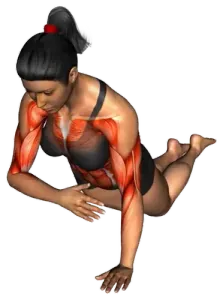
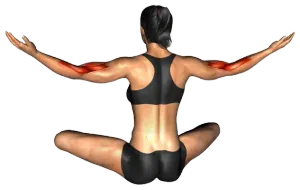

How to do the Seated Shoulder-Tap
Sit on the ground with your legs crossed, spine straight, and arms extended at shoulder level.
With your palms facing down, engage your core muscles to stabilize your upper body.
On an exhale, reach your right hand across your body to gently tap your left shoulder.
Inhale as you extend your right arm back out to the starting position, keeping it in line with your shoulder.
On the next exhale, repeat the movement with your left hand reaching across to tap your right shoulder.
Alternate the shoulder taps, ensuring that you maintain a slow and controlled pace to properly warm up your joints and increase upper-body coordination.
Continue to alternate for the recommended number of repetitions and sets, taking care to maintain good posture throughout the exercise.
---
Seated Shoulder-Tap FAQs
What muscles does the Seated Shoulder-Tap work?
The Seated Shoulder-Tap mainly works the shoulders and triceps, with help from the core. The main muscles are the anterior deltoid, lateral deltoid and triceps brachii.
What equipment do you need for the Seated Shoulder-Tap?
None. The Seated Shoulder-Tap is a bodyweight exercise, so you can do it anywhere.
What workout day should the Seated Shoulder-Tap go on?
It belongs on push day in a push/pull/legs routine.
What are some Seated Shoulder-Tap variations and alternatives?
Similar exercises include the Decline Shoulder-Tap, Incline Shoulder-Tap, Alternating 4-Point Core Stability Shoulder-Tap Position and Seated Neck Tap.
Training calculators
Work out the numbers behind your training before your next session.