Seated Neck Tap
Improve shoulder mobility and activate neck & upper back muscles with Seated Neck Taps! A great warm-up for any workout.
The Seated Neck Tap mainly works the shoulders, with help from the traps and back. No equipment needed: it uses just your bodyweight.

Seated Neck Tap Muscles Worked
Primary
Rear Shoulder (Delts) (posterior deltoid); Rotator Cuff (infraspinatus)
Secondary
Mid Traps (trapezius, middle fibers); Rhomboids (Shoulder Blade) (rhomboids, major & minor)
Seated Neck Tap Variations and Alternatives


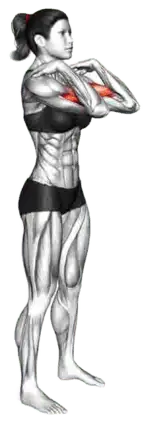


How to do the Seated Neck Tap
Sit down on the floor with your legs crossed, back straight, and arms extended at shoulder level. This is your starting position.
Rotate your arms backward while keeping your arms parallel to the ground, so that your thumbs point to the back and your palms face up.
Bend your elbows and gently tap the base of your neck with your fingertips. Your elbows should point to the sides.
Return to the starting position by reversing the movement: straighten your elbows back to a position where your arms are extended at shoulder level with palms facing up.
Rotate your arms forward to the initial position with your arms extended and palms facing down.
Repeat the sequence for the desired number of repetitions or time duration, focusing on smooth, controlled motion throughout.
This exercise helps with shoulder mobility and activates muscles in the neck, shoulders, and upper back, making it suitable as a warm-up activity to prepare the muscles and joints for more strenuous exercise.
---
Seated Neck Tap FAQs
What muscles does the Seated Neck Tap work?
The Seated Neck Tap mainly works the shoulders, with help from the traps and back. The main muscles are the posterior deltoid and infraspinatus.
What equipment do you need for the Seated Neck Tap?
None. The Seated Neck Tap is a bodyweight exercise, so you can do it anywhere.
What are some Seated Neck Tap variations and alternatives?
Similar exercises include the Seated Shoulder-Tap, Chair Seated Shoulder-Tap, Standing Front Shoulder-Tap and Behind-Neck Arms-Forward.
Training calculators
Work out the numbers behind your training before your next session.