Band Seated Lateral Raise
Strengthen your shoulders with Band Seated Lateral Raises! A simple, effective exercise for building upper body strength.
The Band Seated Lateral Raise mainly works the shoulders, with help from the traps. You'll need: chair or resistance bands.

Required Equipment


Band Seated Lateral Raise Muscles Worked
Primary
Side Shoulder (lateral deltoid)
Secondary
Upper Traps (trapezius, upper fibers)
Band Seated Lateral Raise Variations and Alternatives


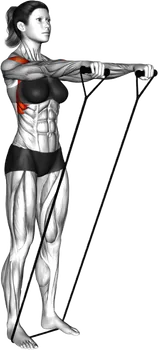
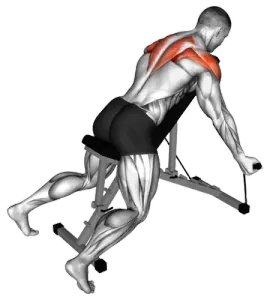

How to do the Band Seated Lateral Raise
Start by sitting on a bench or chair with your back straight and feet flat on the ground. Make sure your posture is upright throughout the exercise.
Place a resistance band under both feet and hold the handles with a neutral grip (palms facing inwards) at your sides. Ensure the band has equal tension on both sides.
Keeping your core engaged, lift both arms out to the sides with elbows slightly bent, not exceeding shoulder height.
Raise your arms to the side until they're parallel to the ground. Focus on using your shoulder muscles to perform the lift, rather than using momentum.
Hold the top position for a brief pause, then slowly lower your arms back to the starting position.
Repeat for the desired number of repetitions.
Ensure that you maintain controlled movements both on the ascent and descent to fully engage the deltoids and provide constant tension with the resistance band.
---
Band Seated Lateral Raise FAQs
What muscles does the Band Seated Lateral Raise work?
The Band Seated Lateral Raise mainly works the shoulders, with help from the traps. The main muscles are the lateral deltoid.
What equipment do you need for the Band Seated Lateral Raise?
Chair or resistance bands.
What workout day should the Band Seated Lateral Raise go on?
It belongs on push day in a push/pull/legs routine.
What are some Band Seated Lateral Raise variations and alternatives?
Similar exercises include the Band Bent-Over Lateral Rear Raise, Band Lateral Front Raise, Band Front Raise and Band Incline T Raise.
Training calculators
Work out the numbers behind your training before your next session.