Standing Behind Sky Reach
Reach for the sky & improve flexibility with Standing Behind Sky Reach! Stretch your obliques and torso in this simple, effective exercise.
The Standing Behind Sky Reach mainly works the core, with help from the back. No equipment needed: it uses just your bodyweight.


Standing Behind Sky Reach Muscles Worked
Primary
Obliques; Abdominals (rectus abdominis)
Secondary
Lats (latissimus dorsi); Deep Core (transverse abdominis)
Standing Behind Sky Reach Variations and Alternatives


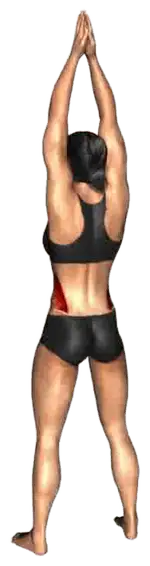


How to do the Standing Behind Sky Reach
Stand straight with your feet hip-width apart. Keep your arms by your sides and maintain good posture with shoulders back and chest up.
Place one hand on your hip to provide stability.
Inhale, raise the opposite arm overhead, and slowly bend your torso to the side where your hand is on your hip. Keep your hips facing forward and do not twist your body.
Reach with the raised hand as if trying to touch the sky, creating a line of stretch from your waist to the tips of your fingers.
Hold this position for 15-30 seconds, feeling a stretch along the side of your abdomen and obliques.
Exhale and slowly return to the starting position.
Switch hands and repeat the stretch on the other side.
Perform the stretch a few times on each side, ensuring you maintain controlled breathing throughout the exercise. This move is great for improving flexibility in the obliques and lateral torso muscles.
---
Standing Behind Sky Reach FAQs
What muscles does the Standing Behind Sky Reach work?
The Standing Behind Sky Reach mainly works the core, with help from the back. The main muscles are the obliques and rectus abdominis.
What equipment do you need for the Standing Behind Sky Reach?
None. The Standing Behind Sky Reach is a bodyweight exercise, so you can do it anywhere.
What are some Standing Behind Sky Reach variations and alternatives?
Similar exercises include the Diagonal Bend Hold, Kickstand Reach with Lateral Lean Stretch, Side-Bend Arm-Above and Side-Bend Arm Stretch.
Training calculators
Work out the numbers behind your training before your next session.