Foam-Roll Thoracic Extension
Improve upper back mobility and posture. Release tension with this simple foam rolling exercise.
The Foam-Roll Thoracic Extension mainly works the lower back and back. You'll need: foam roller.
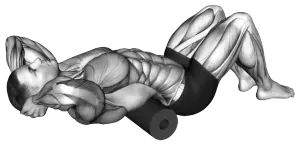

Required Equipment

Foam-Roll Thoracic Extension Muscles Worked
Primary
Spinal Erectors (erector spinae); Lats (latissimus dorsi)
Secondary
Rhomboids (Shoulder Blade) (rhomboids, major & minor); Lower Back (quadratus lumborum)
Foam-Roll Thoracic Extension Variations and Alternatives


How to do the Foam-Roll Thoracic Extension
Start by lying on the floor with your knees bent and feet flat on the ground.
Place a foam roller horizontally underneath your upper-middle back (thoracic spine).
Cross your arms in front of you, or place your hands behind your head to support your neck.
Lift your hips off the ground slightly to apply pressure on the thoracic spine against the foam roller.
Gently roll back and forth across the foam roller, focusing on the section of the thoracic spine that feels tight or stiff. Avoid rolling over the lower back or neck.
Move slowly and pause on particular tight spots to allow them to release. Breathe deeply as you do this.
Continue for 30 seconds to a few minutes, depending on your comfort and the level of muscle tightness.
Use this technique as a part of your warm-up routine or for recovery after workouts.
---
Foam-Roll Thoracic Extension FAQs
What muscles does the Foam-Roll Thoracic Extension work?
The Foam-Roll Thoracic Extension mainly works the lower back and back. The main muscles are the erector spinae and latissimus dorsi.
What equipment do you need for the Foam-Roll Thoracic Extension?
Foam roller.
What are some Foam-Roll Thoracic Extension variations and alternatives?
Similar exercises include the Foam-Roll Serratu Wall Slide, Foam-Roll Chest Alternative, Foam-Roll Hamstring and Foam-Roll Upper-Back.
Training calculators
Work out the numbers behind your training before your next session.