Ring Swing
Swing into fitness! Build upper body strength and coordination with this gymnastics-inspired exercise. Fun, challenging, and effective!
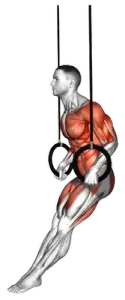
The Ring Swing is a compound exercise that mainly works the back and traps, with help from the core. You'll need: gymnastic rings.

Required Equipment

Ring Swing Muscles Worked
Primary
Lats (latissimus dorsi); Mid Traps (trapezius, middle fibers)
Secondary
Rhomboids (Shoulder Blade) (rhomboids, major & minor); Abdominals (rectus abdominis)
Ring Swing Variations and Alternatives




How to do the Ring Swing
Step 1: Adjust the rings so that they hang at a height that allows you to swing without touching the floor.
Step 2: Begin by grabbing the rings with an overhand grip, standing directly under them with your arms fully extended.
Step 3: Jump up so that your feet leave the floor and assume a hollow body position: legs straight and together, toes pointed, and core engaged to keep your body in a slightly rounded position.
Step 4: Start to generate momentum by leaning backward and then forward, allowing your body to swing beneath the rings.
Step 5: Keep a tight core and active shoulders throughout the swings. The legs should remain straight, using your body's natural lever to help generate motion.
Step 6: Focus on creating a smooth and controlled rhythm, increasing the amplitude of the swing with each pass. The body should travel through a near-horizontal position at the peak of the forward swing and a similar angle on the backward swing.
Step 7: To exit the swing, gradually decrease the amplitude until you can safely come to a stop and place your feet back on the ground.
Notes:\n - Ensure a safe landing area and that the rings are securely fastened.\n - A spotter or coach is recommended for those new to this exercise, as the motion requires practice to master safely.\n - Do not attempt to swing too high until you are confident and have been properly trained, as losing control can lead to falls and injuries.
Ring Swing FAQs
What muscles does the Ring Swing work?
The Ring Swing mainly works the back and traps, with help from the core. The main muscles are the latissimus dorsi and trapezius.
What equipment do you need for the Ring Swing?
Gymnastic rings.
Is the Ring Swing a compound exercise?
Yes. It's a compound movement, meaning it trains several muscle groups at once rather than isolating one.
What are some Ring Swing variations and alternatives?
Similar exercises include the Ape Traverse, Ring Lever Back, Ring Back-Roll to Supported and Ring Lever Front.
Training calculators
Work out the numbers behind your training before your next session.