Ring Handstand to L-Sit
Master the Ring Handstand to L-Sit! Build extreme strength, balance & control. A challenging gymnastic feat for advanced athletes.
The Ring Handstand to L-Sit is a compound exercise that mainly works the core and back, with help from the triceps. You'll need: gymnastic rings.

Required Equipment

Ring Handstand to L-Sit Muscles Worked
Primary
Abdominals (rectus abdominis); Lats (latissimus dorsi)
Secondary
Obliques; Triceps (triceps brachii)
Ring Handstand to L-Sit Variations and Alternatives


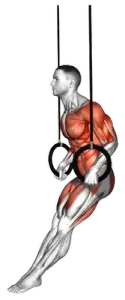


How to do the Ring Handstand to L-Sit
Ensure gymnastic rings are safely and securely fastened at an appropriate height to allow for inverted movements.
Grab the rings with a firm grip and jump up, using your momentum to invert your body into a handstand position with legs fully extended upwards and your feet pointing towards the ceiling. Your arms should be straight, supporting your weight.
Once stable in the handstand position, carefully lower your body by bending your arms and controlling the movement with your shoulder and core strength until you reach a tucked position with your knees towards your chest.
From the tucked position, slowly extend your legs forward while keeping your arms straight, moving into an L-Sit position. Your body should form a right angle, with legs parallel to the ground.
Hold the L-Sit for a prescribed duration, engaging your core muscles to maintain the position.
After holding the L-Sit, tuck your knees back towards your chest to reverse the movement.
Use your core and shoulder strength to press your body back up to the inverted handstand position.
Stabilize the handstand for a moment and then carefully dismount, or continue repeating the movement for the desired number of repetitions.
Please note: This exercise is extremely challenging and requires significant strength, control, and prior gymnastic experience. It should be performed under supervision or with a spotter, especially when first attempting it. Ensure a proper warm-up before attempting this exercise and a soft landing surface beneath the rings for safety.
---
Ring Handstand to L-Sit FAQs
What muscles does the Ring Handstand to L-Sit work?
The Ring Handstand to L-Sit mainly works the core and back, with help from the triceps. The main muscles are the rectus abdominis and latissimus dorsi.
What equipment do you need for the Ring Handstand to L-Sit?
Gymnastic rings.
Is the Ring Handstand to L-Sit a compound exercise?
Yes. It's a compound movement, meaning it trains several muscle groups at once rather than isolating one.
What are some Ring Handstand to L-Sit variations and alternatives?
Similar exercises include the L-Sit, Ring Lever Back, Ring Back-Roll to Supported and Ring Lever Front.
Training calculators
Work out the numbers behind your training before your next session.