L-Sit
Build incredible core strength with L-Sits! This challenging exercise targets your abs, shoulders, and hip flexors for serious gains.
The L-Sit mainly works the core, with help from the chest and triceps. You'll need: high parallel bars.
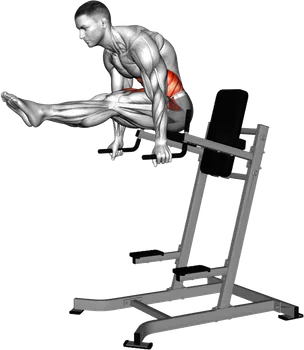

Required Equipment

L-Sit Muscles Worked
Primary
Abdominals (rectus abdominis); Deep Core (transverse abdominis)
Secondary
Upper Chest (pectoralis major, clavicular head); Triceps (triceps brachii)
L-Sit Variations and Alternatives
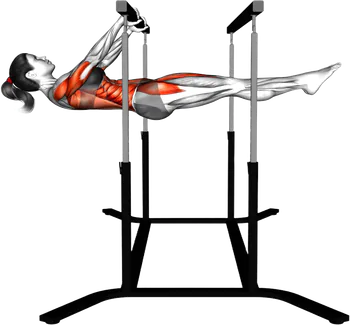


How to do the L-Sit
Start by standing between the parallel bars, grabbing each bar with your hands firmly planted and arms fully extended.
Engage your core muscles and press down onto the bars to lift your body off the ground.
While keeping your legs straight and together, raise them in front of you until they are parallel to the ground, forming an "L" shape with your body.
Ensure that your arms remain straight, your shoulders are down and away from your ears, and your chest is slightly forward. This will help balance your weight.
Keep your core tight and your legs straight throughout the hold. Avoid bending the knees or letting the hips sag down.
Hold the position for as long as possible while maintaining good form. Start with short durations and increase the time as your strength improves.
Carefully lower your legs and dismount from the bars once you have completed the exercise or if your form begins to suffer.
Note: This is a challenging exercise that requires a significant amount of core strength, so it's important to progress to it gradually. Beginners should start with simpler core exercises and work their way up to the L Sit.
---
L-Sit FAQs
What muscles does the L-Sit work?
The L-Sit mainly works the core, with help from the chest and triceps. The main muscles are the rectus abdominis and transverse abdominis.
What equipment do you need for the L-Sit?
High parallel bars.
What are some L-Sit variations and alternatives?
Similar exercises include the Lever Front, Lever Hanging Front Hold, L-Sit Out Kick and L-Sit Chin-Up.
Training calculators
Work out the numbers behind your training before your next session.