Reverse Dip
Target your triceps with Reverse Dips! A bodyweight exercise you can do anywhere to sculpt your arms.
The Reverse Dip is a compound exercise that mainly works the triceps, with help from the chest and shoulders. No equipment needed: it uses just your bodyweight.
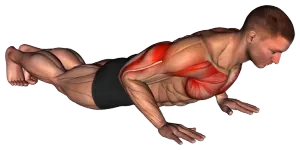

Reverse Dip Muscles Worked
Primary
Triceps (triceps brachii)
Secondary
Upper Chest (pectoralis major, clavicular head); Front Shoulder (anterior deltoid)
Reverse Dip Variations and Alternatives


How to do the Reverse Dip
Sit on the floor with your hands placed behind you, fingers facing forward, and arms straight.
Extend your legs in front of you so that your heels are on the ground and your body is in a straight line.
Lower your body by bending your elbows, ensuring they track directly backward and not flaring out.
Continue to lower yourself until your bottom is just above the ground or until your upper arms are parallel to the floor.
Push through your palms, extending your elbows to lift your body back up to the starting position.
Keep your core tight and engaged throughout the movement to maintain stability and prevent your hips from sagging.
Repeat the movement for the desired number of repetitions and sets.
It's important to perform the exercise with proper form to maximize its effectiveness and reduce the risk of injury.
---
Reverse Dip FAQs
What muscles does the Reverse Dip work?
The Reverse Dip mainly works the triceps, with help from the chest and shoulders. The main muscles are the triceps brachii.
What equipment do you need for the Reverse Dip?
None. The Reverse Dip is a bodyweight exercise, so you can do it anywhere.
Is the Reverse Dip a compound exercise?
Yes. It's a compound movement, meaning it trains several muscle groups at once rather than isolating one.
What workout day should the Reverse Dip go on?
It belongs on push day in a push/pull/legs routine.
What are some Reverse Dip variations and alternatives?
Similar exercises include the Bodyweight Bench Dip, Chest Dip, Chair Floor Dip and Reverse Elbow Lift Push-Up.
Training calculators
Work out the numbers behind your training before your next session.