Chest Dip
Dips target chest, triceps & shoulders. A challenging bodyweight exercise for strength & definition. Advance with added weight!
The Chest Dip is a compound exercise that mainly works the chest and shoulders, with help from the triceps. You'll need: dip bars.
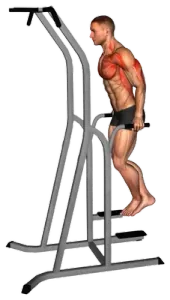
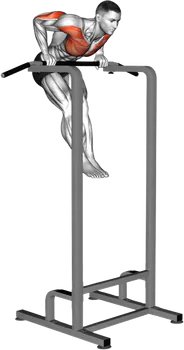

Required Equipment

Chest Dip Muscles Worked
Primary
Chest (pectoralis major, sternal head); Front Shoulder (anterior deltoid)
Secondary
Triceps (triceps brachii)
Chest Dip Variations and Alternatives


How to do the Chest Dip
Approach the dip bars or dip station and grip them tightly with your palms facing inward.
Position yourself above the bars with your arms straight, supporting your entire body weight.
Lean forward slightly to place more emphasis on the chest muscles.
Slowly lower your body by bending your elbows until your shoulders are just below your elbows, or as far as comfortable, ensuring you keep your elbows in line with your body and do not flare them outwards.
Press back up by extending your arms and returning to the starting position with your arms fully extended.
Keep your movements controlled throughout the exercise to maximize muscle tension and minimize the risk of injury.
Repeat for the desired number of repetitions and sets.
To increase the difficulty, you can add weight by using a weight belt or holding a dumbbell between your ankles or legs.
---
Chest Dip FAQs
What muscles does the Chest Dip work?
The Chest Dip mainly works the chest and shoulders, with help from the triceps. The main muscles are the pectoralis major and anterior deltoid.
What equipment do you need for the Chest Dip?
Dip bars.
Is the Chest Dip a compound exercise?
Yes. It's a compound movement, meaning it trains several muscle groups at once rather than isolating one.
What workout day should the Chest Dip go on?
It belongs on push day in a push/pull/legs routine.
What are some Chest Dip variations and alternatives?
Similar exercises include the Machine Assisted Dips, Band Assisted Dip, Bodyweight Bench Dip and Parallel-Bar Deep Push-Up.
Training calculators
Work out the numbers behind your training before your next session.