Front Plank
UpdatedStrengthen your core with the front plank! Hold the position to build endurance and stability. A simple, effective exercise for all fitness levels.
The Front Plank mainly works the core, with help from the lower back and back. No equipment needed: it uses just your bodyweight.
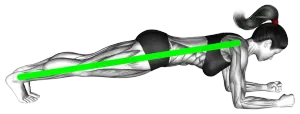

Front Plank Muscles Worked
Primary
Abdominals (rectus abdominis); Deep Core (transverse abdominis)
Secondary
Spinal Erectors (erector spinae); Obliques; Lats (latissimus dorsi)
Front Plank Variations and Alternatives


How to do the Front Plank
Start in a prone position on the ground, with your forearms and toes as the points of contact.
Raise your body up into a straight line, from your heels to your head. Make sure your elbows are directly below your shoulders and your forearms are facing forward.
Engage your core by tightening your abdominal muscles to prevent your hips from sagging or raising too high.
Keep your back straight and neutral, with your shoulders pulled down and back.
Hold this position, maintaining a tight core and controlled breathing.
Aim to maintain the hold for as long as possible without compromising form.
To end the exercise, gently lower your body back to the ground.
It is important to perform the plank with proper form to avoid strain on the back and to effectively work the target muscle groups.
---
Front Plank FAQs
What muscles does the Front Plank work?
The Front Plank mainly works the core, with help from the lower back and back. The main muscles are the rectus abdominis and transverse abdominis.
What equipment do you need for the Front Plank?
None. The Front Plank is a bodyweight exercise, so you can do it anywhere.
What are some Front Plank variations and alternatives?
Similar exercises include the Quadruped Hold Plank, Saw Plank, Chinese Plank and Finger Raises Plank.
Training calculators
Work out the numbers behind your training before your next session.