Saw Plank
Challenge your core with the Saw Plank! This advanced plank variation builds stability & strength, sculpting your abs with every rep.
The Saw Plank mainly works the core, with help from the chest. No equipment needed: it uses just your bodyweight.
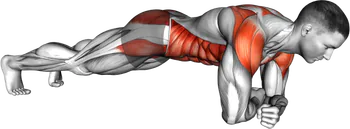

Saw Plank Muscles Worked
Primary
Abdominals (rectus abdominis); Deep Core (transverse abdominis)
Secondary
Obliques; Upper Chest (pectoralis major, clavicular head)
Saw Plank Variations and Alternatives


How to do the Saw Plank
Begin in a traditional forearm plank position with your elbows under your shoulders, forearms flat on the floor, and legs extended behind you. Engage your core to keep your body in a straight line from head to heels.
Without raising or dropping your hips, use your forearms to slowly push your body back, shifting your weight towards your heels as much as comfortable.
Pause at the furthest point you can maintain control and form.
Use your forearm strength and core to pull your body back to the starting forearm plank position.
Repeat the forward and backward movement, resembling the motion of a saw, for a set number of repetitions or period of time.
Ensure you maintain proper form throughout the exercise, keeping the core engaged, hips aligned with the body, and breathing continuously.
Note: To maintain form and to derive the full benefit of the exercise, it's important to avoid letting your hips sag or pike up during the movement.
---
Saw Plank FAQs
What muscles does the Saw Plank work?
The Saw Plank mainly works the core, with help from the chest. The main muscles are the rectus abdominis and transverse abdominis.
What equipment do you need for the Saw Plank?
None. The Saw Plank is a bodyweight exercise, so you can do it anywhere.
What are some Saw Plank variations and alternatives?
Similar exercises include the Back Step Plank, Quadruped Hold Plank, Chinese Plank and Dynamic Elbow Up-Down Plank.
Training calculators
Work out the numbers behind your training before your next session.