Surfer Squat
Master balance and lower-body endurance with the Surfer Squat. This constant-tension exercise uses a deep squat and lateral pivots to fire up your glutes, quads, and core. No jumping required.
The Surfer Squat is a compound exercise that mainly works the quads and glutes & hips, with help from the hamstrings and core. No equipment needed: it uses just your bodyweight.
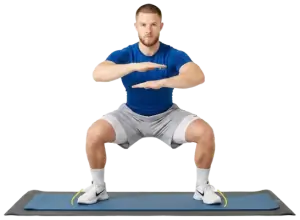


Surfer Squat Muscles Worked
Primary
Quads (quadriceps femoris); Glutes (gluteus maximus)
Secondary
Hamstrings; Obliques
How to do the Surfer Squat
Starting Position
Stand with your feet slightly wider than shoulder-width apart. Keep your core engaged and your chest up.
The Movement
Squat Down: Initiate the movement by pushing your hips back and bending your knees, lowering your body into a deep squat position. Ensure your knees are aligned with your toes.
The Pivot: Instead of jumping, quickly pivot your body and feet to face about 90 degrees to one side. Keep your feet in contact with the floor while pivoting.
Controlled Landing: As you pivot, ensure your legs remain in the deep squat position to maintain constant tension on the muscles.
Return: Pivot back to the center or through the full range of motion to the opposite side while staying low in the squat throughout the transition.
Form Tips
Keep your chest lifted throughout the movement to prevent rounding your back.
Use your core muscles to control the speed and stability of the pivot.
This is a continuous movement; avoid standing up fully between transitions.
Surfer Squat FAQs
What muscles does the Surfer Squat work?
The Surfer Squat mainly works the quads and glutes & hips, with help from the hamstrings and core. The main muscles are the quadriceps femoris and gluteus maximus.
What equipment do you need for the Surfer Squat?
None. The Surfer Squat is a bodyweight exercise, so you can do it anywhere.
Is the Surfer Squat a compound exercise?
Yes. It's a compound movement, meaning it trains several muscle groups at once rather than isolating one.
Training calculators
Work out the numbers behind your training before your next session.