Chair Seated Pelvi Imbalance Hold Twist
Improve balance & flexibility with this seated twist. Gently target core muscles & lower back. Great for desk workers!
The Chair Seated Pelvi Imbalance Hold Twist mainly works the core, with help from the lower back. You'll need: chair.

Required Equipment

Chair Seated Pelvi Imbalance Hold Twist Muscles Worked
Primary
Obliques; Deep Core (transverse abdominis)
Secondary
Abdominals (rectus abdominis); Spinal Erectors (erector spinae)
Chair Seated Pelvi Imbalance Hold Twist Variations and Alternatives


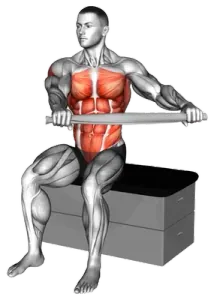
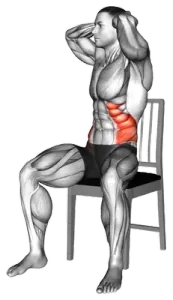
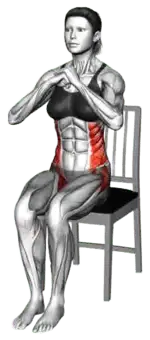
How to do the Chair Seated Pelvi Imbalance Hold Twist
Sitting Pelvis Imbalance Twist on a Chair
Positioning
Sit on the Chair:
Start by sitting on the edge of a sturdy chair.
Ensure your feet are flat on the floor, hip-width apart.
Keep your back straight and shoulders relaxed.
Core Engagement:
Engage your core muscles. Imagine drawing your belly button towards your spine.
Movement
Starting Position:
Place your hands on your thighs or at your sides for stability.
Twisting:
Take a deep breath in.
As you exhale, slowly twist your upper body to the right.
Use your left hand to hold onto the right side of the chair for support.
Keep your hips facing forward, allowing only your torso to move.
Hold the Position:
Hold the twist for 10-15 seconds, breathing normally.
Feel the stretch in your lower back and the sides of your abdomen.
Return to Center:
Inhale as you slowly return to the starting position, facing forward.
Repeat on the Other Side:
Exhale and twist your upper body to the left.
Use your right hand to hold onto the left side of the chair.
Hold for another 10-15 seconds.
Finishing:
Return to the center and relax your posture.
Repeat the twists 2-3 times on each side.
Tips
Move slowly and gently; do not force the twist.
Focus on breathing deeply to enhance relaxation.
Ensure the chair is stable to prevent any accidental falls.
Chair Seated Pelvi Imbalance Hold Twist FAQs
What muscles does the Chair Seated Pelvi Imbalance Hold Twist work?
The Chair Seated Pelvi Imbalance Hold Twist mainly works the core, with help from the lower back. The main muscles are the obliques and transverse abdominis.
What equipment do you need for the Chair Seated Pelvi Imbalance Hold Twist?
Chair.
What are some Chair Seated Pelvi Imbalance Hold Twist variations and alternatives?
Similar exercises include the Chair Revolved, Stool Seated Twist Stretch, Stool Towel Seated Twist and Chair Seated Upright Twist.
Training calculators
Work out the numbers behind your training before your next session.