Side-Bridge
Strengthen your core with the 1-Bridge! Improve stability and posture with this simple yet effective bodyweight exercise.
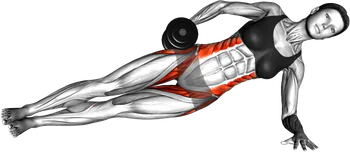
The Side-Bridge mainly works the core, with help from the hip abductors (outer thighs) and lower back. No equipment needed: it uses just your bodyweight.

Side-Bridge Muscles Worked
Primary
Obliques; Abdominals (rectus abdominis)
Secondary
Hip Abductor (gluteus medius); Lower Back (quadratus lumborum)
Side-Bridge Variations and Alternatives


How to do the Side-Bridge
Start by lying on your side with your legs extended, feet stacked on top of each other, and one arm (the bottom arm) directly under your shoulder.
Engage your core and lift your hips off the ground, forming a straight line from your ankles to your shoulders. Keep your head in line with your spine.
Place your top hand on your hip or extend it towards the ceiling for added stability.
Hold this position, making sure your hips don't sag or lift too high. Keep your core engaged throughout.
Maintain this position for the desired duration.
Slowly lower your hips back to the floor to come out of the pose.
Repeat on the other side for a balanced workout.
Ensure to breathe normally throughout the exercise, and avoid holding your breath. Remember to perform the movement with controlled and smooth motions, without any jerky or sudden movements.
---
Side-Bridge FAQs
What muscles does the Side-Bridge work?
The Side-Bridge mainly works the core, with help from the hip abductors (outer thighs) and lower back. The main muscles are the obliques and rectus abdominis.
What equipment do you need for the Side-Bridge?
None. The Side-Bridge is a bodyweight exercise, so you can do it anywhere.
What are some Side-Bridge variations and alternatives?
Similar exercises include the Dumbbell Side-Bridge, Dumbbell Bent-Leg Side-Bridge, Ifbb Pose and Ring Side-Bridge.
Training calculators
Work out the numbers behind your training before your next session.