Seated & Side-Bend
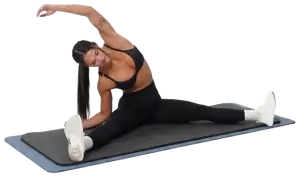
The Seated & Side-Bend mainly works the core and hip adductors (inner thighs), with help from the lower back and back. No equipment needed: it uses just your bodyweight.


Optional Equipment

Seated & Side-Bend Muscles Worked
Primary
Obliques; Hip Adductors
Secondary
Spinal Erectors (erector spinae); Lats (latissimus dorsi)
How to do the Seated & Side-Bend
Setup
Sit on the floor with your legs spread as wide as comfortably possible in a 'V' shape (straddle position). Keep your spine tall, chest lifted, and heels pressing into the floor.
Movement
Reach one arm overhead while keeping your arm close to your ear.
Lean your torso toward the opposite leg, trying to reach your hand toward your foot while bending at the waist.
Ensure your chest stays open and pointed forward; do not curl your shoulder toward the floor.
Hold the stretch briefly at the bottom of the movement, feeling the stretch along the side of your torso (obliques) and the inner thigh of the extended leg.
Engage your core to return to the upright starting position.
Switch sides by reaching the opposite arm overhead and bending toward the other leg.
Seated & Side-Bend FAQs
What muscles does the Seated & Side-Bend work?
The Seated & Side-Bend mainly works the core and hip adductors (inner thighs), with help from the lower back and back. The main muscles are the obliques and hip adductors.
What equipment do you need for the Seated & Side-Bend?
None. The Seated & Side-Bend is a bodyweight exercise, so you can do it anywhere.
Training calculators
Work out the numbers behind your training before your next session.