Seated Chin Tuck
Improve your posture with Seated Chin Tucks! This simple exercise can help relieve neck tension and correct forward head posture.
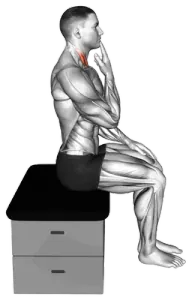
The Seated Chin Tuck mainly works the neck and traps, with help from the back. No equipment needed: it uses just your bodyweight.


Optional Equipment

Seated Chin Tuck Muscles Worked
Primary
Side Neck Flexor (sternocleidomastoid); Neck (back) (levator scapulae); Upper Traps (trapezius, upper fibers)
Secondary
Rhomboids (Shoulder Blade) (rhomboids, major & minor)
Seated Chin Tuck Variations and Alternatives


How to do the Seated Chin Tuck
Positioning:
Start by finding a comfortable and quiet space where you can sit without distractions.
Sit on your knees with your back straight. Ensure that your head is aligned with your spine.
Your shoulders should be relaxed and not hunched.
Place your hands gently on your thighs for stability.
Movement:
Begin by gently retracting your chin towards your neck. Imagine creating a double chin, but do this movement slowly and deliberately.
Hold the position for about 3 to 5 seconds, feeling a gentle stretch in the back of your neck.
Slowly return your head to the starting position.
Repeat this movement for 8 to 10 repetitions.
Focus on maintaining a straight back throughout the exercise to avoid slouching.
Tips:
Keep breathing normally; do not hold your breath.
Perform this exercise within a comfortable range and avoid any pain or discomfort.
This exercise can help improve neck posture and relieve tension.
Seated Chin Tuck FAQs
What muscles does the Seated Chin Tuck work?
The Seated Chin Tuck mainly works the neck and traps, with help from the back. The main muscles are the sternocleidomastoid, levator scapulae and trapezius.
What equipment do you need for the Seated Chin Tuck?
None. The Seated Chin Tuck is a bodyweight exercise, so you can do it anywhere.
What are some Seated Chin Tuck variations and alternatives?
Similar exercises include the 5-Sec Fist Against Chin, Cable Seated Neck Flexion, Chin Tuck and Chin Tuck Hold.
Training calculators
Work out the numbers behind your training before your next session.