Floor Lying Chest Opener Roll
Release chest tension & improve posture! Gently open your chest with this floor-based stretch using a foam roller.
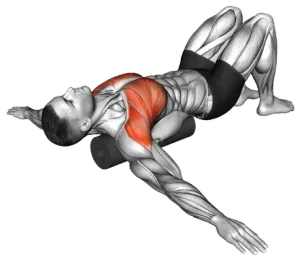
The Floor Lying Chest Opener Roll mainly works the chest, with help from the shoulders and biceps. You'll need: foam roller.

Required Equipment

Floor Lying Chest Opener Roll Muscles Worked
Primary
Chest (pectoralis major, sternal head); Lower Chest (pectoralis minor)
Secondary
Front Shoulder (anterior deltoid); Biceps (biceps brachii)
Floor Lying Chest Opener Roll Variations and Alternatives


How to do the Floor Lying Chest Opener Roll
Place a foam roller on the floor and lie down with the foam roller vertically along your spine, supporting your head, neck, and entire back.
Bend your knees and place your feet flat on the floor for stability.
Extend your arms out to the sides to form a 'T' shape, with palms facing up.
Allow your chest and shoulders to relax and open toward the floor, feeling the stretch in your chest and the front of your shoulders.
Hold this position for 15-30 seconds, taking deep breaths to help deepen the stretch.
If you want to increase the stretch, you can gently rock side to side, rolling your shoulders further onto the ground.
Repeat the stretch two or three times, resting briefly between each repetition.
Remember to perform this stretch gently, and do not force your arms down if it causes discomfort. This stretch should be relaxing and help to open up the chest, improving posture and reducing tension.
---
Floor Lying Chest Opener Roll FAQs
What muscles does the Floor Lying Chest Opener Roll work?
The Floor Lying Chest Opener Roll mainly works the chest, with help from the shoulders and biceps. The main muscles are the pectoralis major and pectoralis minor.
What equipment do you need for the Floor Lying Chest Opener Roll?
Foam roller.
What are some Floor Lying Chest Opener Roll variations and alternatives?
Similar exercises include the Foam-Roll Serratu Wall Slide, Foam-Roll Chest Alternative, Foam-Roll Upper-Back and Open Book Stretch.
Training calculators
Work out the numbers behind your training before your next session.