Band Leg Curl
Strengthen hamstrings anywhere! The Band Leg Curl is a simple, effective exercise for building lower body strength with minimal equipment.
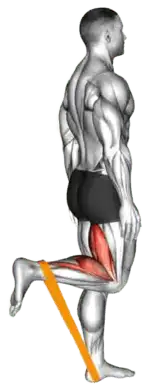
The Band Leg Curl mainly works the hamstrings, with help from the calves / shins and glutes & hips. You'll need: resistance bands.

Required Equipment

Band Leg Curl Muscles Worked
Primary
Hamstrings
Secondary
Upper Calf (gastrocnemius); Glutes (gluteus maximus)
Band Leg Curl Variations and Alternatives


How to do the Band Leg Curl
Find a stable object to anchor the resistance band at ground level.
Attach one end of the resistance band to the stable object and the other around your ankle.
Stand facing away from the anchor point with your feet hip-width apart.
Shift your weight onto your non-working leg. Keep a slight bend in your standing knee for stability.
Slowly flex the knee of the working leg, pulling your heel towards your glutes against the resistance of the band.
Pause briefly at the top of the movement where your hamstring is fully contracted.
Slowly return your foot back to the starting position, resisting the pull of the band.
Perform the recommended number of repetitions and then switch legs.
Ensure you keep your hips stable and avoid swinging your leg or using momentum to perform the curl. Maintain control throughout the entire movement for maximal muscle engagement and safety. Adjust the resistance of the band as needed to match your strength level.
---
Band Leg Curl FAQs
What muscles does the Band Leg Curl work?
The Band Leg Curl mainly works the hamstrings, with help from the calves / shins and glutes & hips. The main muscles are the hamstrings.
What equipment do you need for the Band Leg Curl?
Resistance bands.
What workout day should the Band Leg Curl go on?
It belongs on leg day in a push/pull/legs routine.
What are some Band Leg Curl variations and alternatives?
Similar exercises include the Band Standing Leg Curl, Cable Hamstring Curl, Exercise Ball Leg Curl and Resistance-Band Assisted Nordic Hamstring Curl.
Training calculators
Work out the numbers behind your training before your next session.