Resistance-Band Assisted Single-Arm Pull-Up
The Resistance-Band Assisted Single-Arm Pull-Up is a compound exercise that mainly works the back and biceps, with help from the shoulders and core. You'll need: pull up bar and resistance bands.
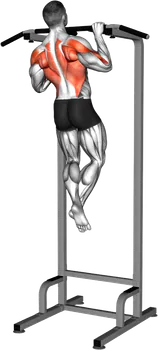

Required Equipment


Resistance-Band Assisted Single-Arm Pull-Up Muscles Worked
Primary
Lats (latissimus dorsi); Biceps (biceps brachii)
Secondary
Outer Lats (teres major); Rear Shoulder (Delts) (posterior deltoid); Abdominals (rectus abdominis)
How to do the Resistance-Band Assisted Single-Arm Pull-Up
Secure a resistance band over the pull-up bar and place one hand firmly around the bar in an overhand or neutral grip.
Place your opposite foot or knee securely inside the bottom loop of the resistance band for assistance.
Engage your core and pull your body upward by driving your elbow down toward your ribs until your chin clears the bar.
Pause briefly at the top while keeping your chest lifted toward your hand.
Lower yourself back down in a slow, controlled motion until your arm is fully extended.
Resistance-Band Assisted Single-Arm Pull-Up FAQs
What muscles does the Resistance-Band Assisted Single-Arm Pull-Up work?
The Resistance-Band Assisted Single-Arm Pull-Up mainly works the back and biceps, with help from the shoulders and core. The main muscles are the latissimus dorsi and biceps brachii.
What equipment do you need for the Resistance-Band Assisted Single-Arm Pull-Up?
Pull up bar and resistance bands.
Is the Resistance-Band Assisted Single-Arm Pull-Up a compound exercise?
Yes. It's a compound movement, meaning it trains several muscle groups at once rather than isolating one.
What workout day should the Resistance-Band Assisted Single-Arm Pull-Up go on?
It belongs on pull day in a push/pull/legs routine.
Training calculators
Work out the numbers behind your training before your next session.