Prayer Push Hold
Build chest strength with isometric holds! Squeeze your palms together and feel the burn. Simple, effective, and no equipment needed.
The Prayer Push Hold mainly works the chest, with help from the shoulders and triceps. No equipment needed: it uses just your bodyweight.
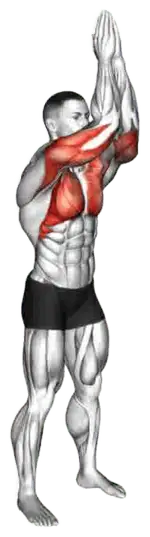

Prayer Push Hold Muscles Worked
Primary
Upper Chest (pectoralis major, clavicular head); Chest (pectoralis major, sternal head)
Secondary
Front Shoulder (anterior deltoid); Triceps (triceps brachii)
Prayer Push Hold Variations and Alternatives


How to do the Prayer Push Hold
Stand up straight with your feet shoulder-width apart.
Bring your palms together at chest level, elbows bent, and fingers pointing upwards. This is the "prayer position."
Press your palms together firmly without letting them slide apart.
Focus on contracting the chest muscles as you push your palms together.
Hold this position, keeping constant tension on the chest muscles for the duration of your set. Ensure you continue breathing normally throughout the hold.
Once the time is up, gently release the tension and relax your arms.
Remember to start with a hold time that feels challenging but not straining, gradually increasing the duration as your strength improves. It's also important to maintain good posture with the shoulders down and back throughout the exercise.
---
Prayer Push Hold FAQs
What muscles does the Prayer Push Hold work?
The Prayer Push Hold mainly works the chest, with help from the shoulders and triceps. The main muscles are the pectoralis major.
What equipment do you need for the Prayer Push Hold?
None. The Prayer Push Hold is a bodyweight exercise, so you can do it anywhere.
What workout day should the Prayer Push Hold go on?
It belongs on push day in a push/pull/legs routine.
What are some Prayer Push Hold variations and alternatives?
Similar exercises include the Bodyweight Svend-Press, Criss-Cross Arm Prayer Push, Deep Push-Up Hold and Elbow Prayer Push Draw Circle.
Training calculators
Work out the numbers behind your training before your next session.