Lying Prone a
Strengthen your back & core with Lying Prone! Improve posture & stability with this simple, effective exercise.
The Lying Prone a mainly works the back and shoulders, with help from the traps. No equipment needed: it uses just your bodyweight.

Lying Prone a Muscles Worked
Primary
Lats (latissimus dorsi); Rear Shoulder (Delts) (posterior deltoid)
Secondary
Rhomboids (Shoulder Blade) (rhomboids, major & minor); Mid Traps (trapezius, middle fibers)
Lying Prone a Variations and Alternatives


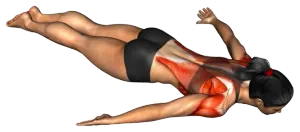
How to do the Lying Prone a
Starting Position:
Lie face down on a flat surface or exercise mat.
Stretch your arms out in front of you so they are aligned with your shoulders, creating a "Y" position with your body.
Body Alignment:
Keep your legs extended straight behind you, with your feet hip-width apart.
Ensure your head and neck are in a neutral position. Your forehead can rest on the ground if comfortable.
Engaging the Core:
Tighten your abdominal muscles to stabilize your body.
Avoid sagging your lower back by keeping your hips pressed into the mat.
Lifting Movement:
Slowly lift your arms, chest, and head off the ground.
Raise your arms until they are parallel to the ground, keeping them straight.
Hold Position:
Hold the lift for a count of 3-5 seconds, breathing normally.
Focus on engaging your back muscles while maintaining tension in your core.
Lowering Movement:
Gently lower your arms, chest, and head back to the starting position.
Repetitions:
Perform 8-12 repetitions, resting for 30 seconds between sets.
Tips:
Ensure your body forms a straight line from your head to your toes during the lift.
Avoid straining your neck; look slightly forward rather than straight down.
If you experience any discomfort, adjust your position or reduce the height of the lift.
Cool Down:
After completing the sets, gently stretch your arms above your head while lying on your stomach to release tension in the back.
Lying Prone a FAQs
What muscles does the Lying Prone a work?
The Lying Prone a mainly works the back and shoulders, with help from the traps. The main muscles are the latissimus dorsi and posterior deltoid.
What equipment do you need for the Lying Prone a?
None. The Lying Prone a is a bodyweight exercise, so you can do it anywhere.
What workout day should the Lying Prone a go on?
It belongs on pull day in a push/pull/legs routine.
What are some Lying Prone a variations and alternatives?
Similar exercises include the Y, I into W, Alternating Lying Back Raise and Lying Arm Slide.
Training calculators
Work out the numbers behind your training before your next session.