Low Lunge
Stretch your hips and strengthen your legs with the Low Lunge. Improve flexibility and stability with this simple, effective pose.
The Low Lunge mainly works the quads and glutes & hips, with help from the core. No equipment needed: it uses just your bodyweight.
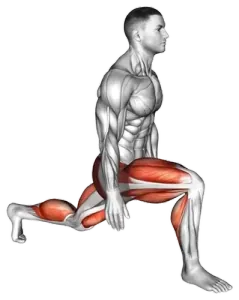

Low Lunge Muscles Worked
Primary
Quads (quadriceps femoris); Glutes (gluteus maximus)
Secondary
Hip Flexor (iliopsoas); Obliques
Low Lunge Variations and Alternatives


How to do the Low Lunge
1. Begin by standing straight with your feet hip-width apart.
2. Step forward with one foot, bending your knee to lower your body towards the ground. Keep your front knee directly above your ankle, not pushed out over your toes.
3. Extend your back leg straight behind you, resting your knee and the top of your foot on the floor, or keeping the back leg slightly lifted for a more active stretch.
4. Keep your torso upright and hands on your hips or place your hands on the ground for balance and support.
5. Engage your hip and core muscles to maintain stability. You should feel a stretch in the hip flexors of your back leg and a strengthening sensation in the front leg's quads and glutes.
6. Hold the position for 15-30 seconds, focusing on deep breathing and maintaining proper alignment.
7. To exit the lunge, push up through the front heel to raise your body back to the starting standing position.
8. Repeat the exercise on the opposite side.
Be sure to perform the lunge with control and avoid any erratic or bouncing movements to maintain muscle engagement and prevent injury.
---
Low Lunge FAQs
What muscles does the Low Lunge work?
The Low Lunge mainly works the quads and glutes & hips, with help from the core. The main muscles are the quadriceps femoris and gluteus maximus.
What equipment do you need for the Low Lunge?
None. The Low Lunge is a bodyweight exercise, so you can do it anywhere.
What workout day should the Low Lunge go on?
It belongs on leg day in a push/pull/legs routine.
What are some Low Lunge variations and alternatives?
Similar exercises include the Alternating Sprinter Lunge, Forward Lunge Pulse, Reverse Lunge and Deep Dorsi Flexion Lunge.
Training calculators
Work out the numbers behind your training before your next session.