Floor T Raise
Strengthen your upper back and improve posture with Floor T Raises. Simple, effective, and scalable for all fitness levels.
The Floor T Raise mainly works the back and shoulders, with help from the traps. No equipment needed: it uses just your bodyweight.
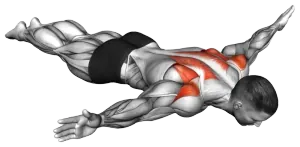

Floor T Raise Muscles Worked
Primary
Rhomboids (Shoulder Blade) (rhomboids, major & minor); Rear Shoulder (Delts) (posterior deltoid)
Secondary
Lats (latissimus dorsi); Mid Traps (trapezius, middle fibers)
Floor T Raise Variations and Alternatives




How to do the Floor T Raise
Lie face down on the floor, legs straight out behind you, with your arms extended to either side, forming a "T" shape with your body. Your forehead should be touching the ground to keep your neck in a neutral position.
Engage your core muscles to stabilize your spine and lower body.
Keeping your arms straight and thumbs pointing toward the ceiling, lift your arms up toward the ceiling, squeezing your shoulder blades together. As you perform the lift, keep your arms level with your shoulders and avoid shrugging.
Hold the raised position for a moment, then slowly lower your arms back to the starting position.
Repeat for the desired number of repetitions and sets, ensuring you maintain proper form throughout each rep.
This exercise is beneficial for improving posture, strengthening the upper back, and promoting scapular retraction and stability. If you're new to this exercise or are looking to focus on form without added weight, perform it using just your body weight. As you get stronger, you can add light dumbbells to increase resistance.
---
Floor T Raise FAQs
What muscles does the Floor T Raise work?
The Floor T Raise mainly works the back and shoulders, with help from the traps. The main muscles are the rhomboids and posterior deltoid.
What equipment do you need for the Floor T Raise?
None. The Floor T Raise is a bodyweight exercise, so you can do it anywhere.
What workout day should the Floor T Raise go on?
It belongs on pull day in a push/pull/legs routine.
What are some Floor T Raise variations and alternatives?
Similar exercises include the Lying Prone T Raise, Lying Prone W to Y, Lying Prone Y to T W and Lying Prone Y to T.
Training calculators
Work out the numbers behind your training before your next session.