Chest & Back Pull
Strengthen your chest & back! This pull exercise is great for building upper body strength. Remember to keep your back straight!
The Chest & Back Pull mainly works the traps and shoulders. No equipment needed: it uses just your bodyweight.
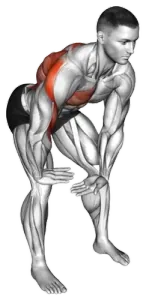

Chest & Back Pull Muscles Worked
Primary
Rear Shoulder (Delts) (posterior deltoid); Mid Traps (trapezius, middle fibers); Lower Traps (trapezius, lower fibers)
Chest & Back Pull Variations and Alternatives


How to do the Chest & Back Pull
Stand with your feet shoulder-width apart and slightly bend your knees.
Lean forward at your hips, keeping your back straight, so your torso is almost parallel to the floor.
Extend your arms straight down towards the ground, keeping a slight bend in the elbows.
Engage your core and retract your shoulder blades, pulling your arms back and up in a reverse fly motion while keeping the elbows slightly bent.
Squeeze your shoulder blades together at the top of the motion, focusing on using your upper back muscles.
Slowly return to the starting position while maintaining control.
Repeat the exercise for the desired number of repetitions and sets.
Note: Ensure you perform the movement with control and avoid using momentum to lift your arms. The focus should be on the contraction of the back muscles.
---
Chest & Back Pull FAQs
What muscles does the Chest & Back Pull work?
The Chest & Back Pull mainly works the traps and shoulders. The main muscles are the posterior deltoid and trapezius.
What equipment do you need for the Chest & Back Pull?
None. The Chest & Back Pull is a bodyweight exercise, so you can do it anywhere.
What workout day should the Chest & Back Pull go on?
It belongs on pull day in a push/pull/legs routine.
What are some Chest & Back Pull variations and alternatives?
Similar exercises include the Back Squeeze, Bodyweight Back & Rear-Delt Raise, Bodyweight Standing Scapula Row and Dumbbell Bent-Over Face Pull.
Training calculators
Work out the numbers behind your training before your next session.