Cable Tricep Kickback
Isolate and strengthen your triceps with Cable Tricep Kickbacks! Perfect for defined arms. Get started now!
The Cable Tricep Kickback mainly works the triceps. You'll need: neutral grip attachment and cable machine.
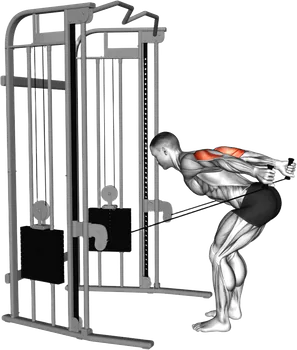
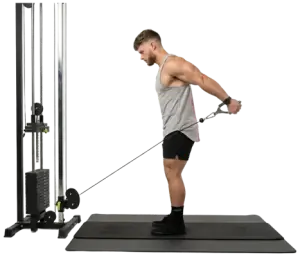

Required Equipment


Cable Tricep Kickback Muscles Worked
Primary
Triceps (triceps brachii)
Cable Tricep Kickback Variations and Alternatives


How to do the Cable Tricep Kickback
Attach a handle to the low pulley of a cable machine and select the desired weight.
Stand facing the machine with your feet shoulder-width apart and a slight bend in your knees.
Lean forward at the hips to achieve a roughly 45-degree angle with your torso.
Grasp the handle with one hand using a neutral grip (palm facing inward) and keep your arm close to your side.
Begin the exercise with your elbow bent so that your forearm is parallel to the floor.
Without moving your upper arm, extend your elbow to push the handle back and straighten your arm fully behind you.
Squeeze your triceps hard at the end of the movement, holding for a count of one.
Slowly return the handle to the starting position, allowing your elbow to bend without the weight touching the stack.
Perform all repetitions for one arm before switching to the other arm.
Aim for multiple sets of an appropriate number of repetitions, making sure to maintain the correct form throughout the exercise.
---
Cable Tricep Kickback FAQs
What muscles does the Cable Tricep Kickback work?
The Cable Tricep Kickback mainly works the triceps. The main muscles are the triceps brachii.
What equipment do you need for the Cable Tricep Kickback?
Neutral grip attachment and cable machine.
What workout day should the Cable Tricep Kickback go on?
It belongs on push day in a push/pull/legs routine.
What are some Cable Tricep Kickback variations and alternatives?
Similar exercises include the Band Tricep Kickback, Bodyweight Double Tricep Kickback, Cable Rope-Handle Neutral-Grip Bent-Over Kickback and Cable Single-Arm Neutral-Grip Bent-Over Kickback.
Training calculators
Work out the numbers behind your training before your next session.