Band Upper Crunch
Strengthen your core with the Band Upper Crunch! This exercise adds resistance to the classic crunch for a more effective workout.
The Band Upper Crunch is a compound exercise that mainly works the core, with help from the lower back. You'll need: resistance bands.

Required Equipment

Band Upper Crunch Muscles Worked
Primary
Abdominals (rectus abdominis)
Secondary
Obliques; Spinal Erectors (erector spinae)
Band Upper Crunch Variations and Alternatives


How to do the Band Upper Crunch
Setup: Attach a resistance band to a low, stable anchor point.
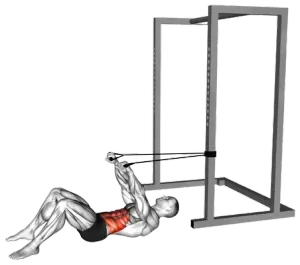
Starting Position: Lie flat on the floor, facing away from the anchor point with your legs bent and feet flat on the floor. Grip the handles of the band with both hands and extend your arms towards the anchor point.
Execution: Engage your core and slowly crunch your upper body upwards, pulling down on the band as you lift your shoulders and upper back off the floor.
Contraction: Squeeze your abdominals at the top of the movement.
Return: Slowly return back to the starting position while maintaining tension on the band. Ensure that the movement is controlled, particularly when returning to the starting position, to avoid any jerking motions that may strain your neck or back.
Repetition: Repeat the crunch for the desired number of repetitions and sets. Focus on fully engaging your core throughout the exercise.
---
Band Upper Crunch FAQs
What muscles does the Band Upper Crunch work?
The Band Upper Crunch mainly works the core, with help from the lower back. The main muscles are the rectus abdominis.
What equipment do you need for the Band Upper Crunch?
Resistance bands.
Is the Band Upper Crunch a compound exercise?
Yes. It's a compound movement, meaning it trains several muscle groups at once rather than isolating one.
What are some Band Upper Crunch variations and alternatives?
Similar exercises include the Band Bicycle-Crunch, Band Decline Sit-Up, Band Jackknife Sit-Up and Band Kneeling Crunch.
Training calculators
Work out the numbers behind your training before your next session.